Rollout results
Before release, the product manager (PM) and operations lead agreed on the measure of adoption: more than half of bookings placed through the redesigned flow needed to be self-scheduled. We counted a booking as self-scheduled when the learner completed it without an advisor placing it on their behalf.
During the transition, the team watched whether returning learners kept booking, as a check that the change was not costing us the people we most wanted to keep, and asked advisors to report time spent on coordination. The team did not have a defensible retention figure to report.
The headline result: within four months of full rollout, more than half of bookings placed through the redesigned flow were completed by learners without an advisor, passing the pre-launch target. We calculated the rate as self-scheduled bookings divided by all bookings placed through the redesigned flow.
Advisors logged fewer hours under the booking-coordination task after rollout. The product did not record exact handling time, so this result comes from advisor reports.
Agent Assist was the chat and callback support inside the booking flow. Weekly transcript reviews showed less use in the weeks after launch. During the same period, the share of self-scheduled bookings increased.
A high-touch service had become a booking bottleneck
TutorComp is an online tutoring service for learners who need one-to-one help in a school subject. Accounts could be managed by a learner or by a parent on their behalf; in this case study, "learner" refers to whoever handled booking on the account. In 2022, TutorComp assigned each learner an academic advisor. Advisors recommended tutors, coordinated sessions and stayed involved as learners built a relationship with a tutor.
Advisor support gave learners a person who knew their history and could answer questions about tutor fit. The same model required advisor involvement for routine scheduling because the product gave learners too little information to choose and book on their own.
When COVID-19 moved schooling online, remote learning pushed demand for one-to-one tutoring up sharply, and self-serve competitors let families book a tutor in minutes. TutorComp could not move at that pace. Every booking waited on a person, so how fast the business could grow was capped by how many advisors it could staff.
- 1The learner contacted an assigned advisor with a subject, tutor preferences and available times.
- 2The advisor compared tutor expertise, fit and schedules, then sent suitable options back to the learner.
- 3The learner reviewed the options and replied with a choice. Questions or schedule changes added another exchange.
- 4The advisor placed the confirmed session against the learner's prepaid credits, the pool of sessions the learner had paid for in advance.
This support gave learners confidence when they chose a tutor for a new subject. Returning learners relied on advisors to remember a previous tutor and arrange the next session.
Advisors repeated the coordination loop for routine bookings, and each change required a new message or call. The PM and operations lead wanted learners to handle routine bookings while advisors focused on academic guidance and complex choices.
Product target
My role
Learners needed context and continuity
Many booking decisions happened outside the interface, during calls and email exchanges. I needed to understand how learners chose a tutor and how advisors filled gaps in the product. I interviewed 12 learners, including people new to TutorComp and people who had booked with the same tutor over time.
I also interviewed six academic advisors. They explained how they assessed subject experience, availability and fit when they made a recommendation. The product team had not documented much of this matching logic, even though learners depended on it.
I used the interviews to identify decision patterns and product risks. A larger study would be required to measure how common each pattern was across the learner base.
Confidence depended on context
Repeat bookings centered on continuity
Advisors supplied reassurance
Coordination delayed booking

Fig. 1 - Learner segment model. I organized the flow around confidence to choose and tutor continuity.
The product needed to give learners enough context to choose a tutor and enough feedback to complete a booking without advisor coordination.
The flow also had to carry forward the parts of the service that learners valued: previous-tutor history, visible credit use and a route to human help. The team had 12 weeks to design and build the first release.
We built a first prototype, V1, to test the booking flow
The PM, engineers and I scoped the first prototype, V1, around the mechanics shared across new and repeat bookings. We needed to test the dependencies between subject, tutor, schedule and credits before the team committed to the revised flow.
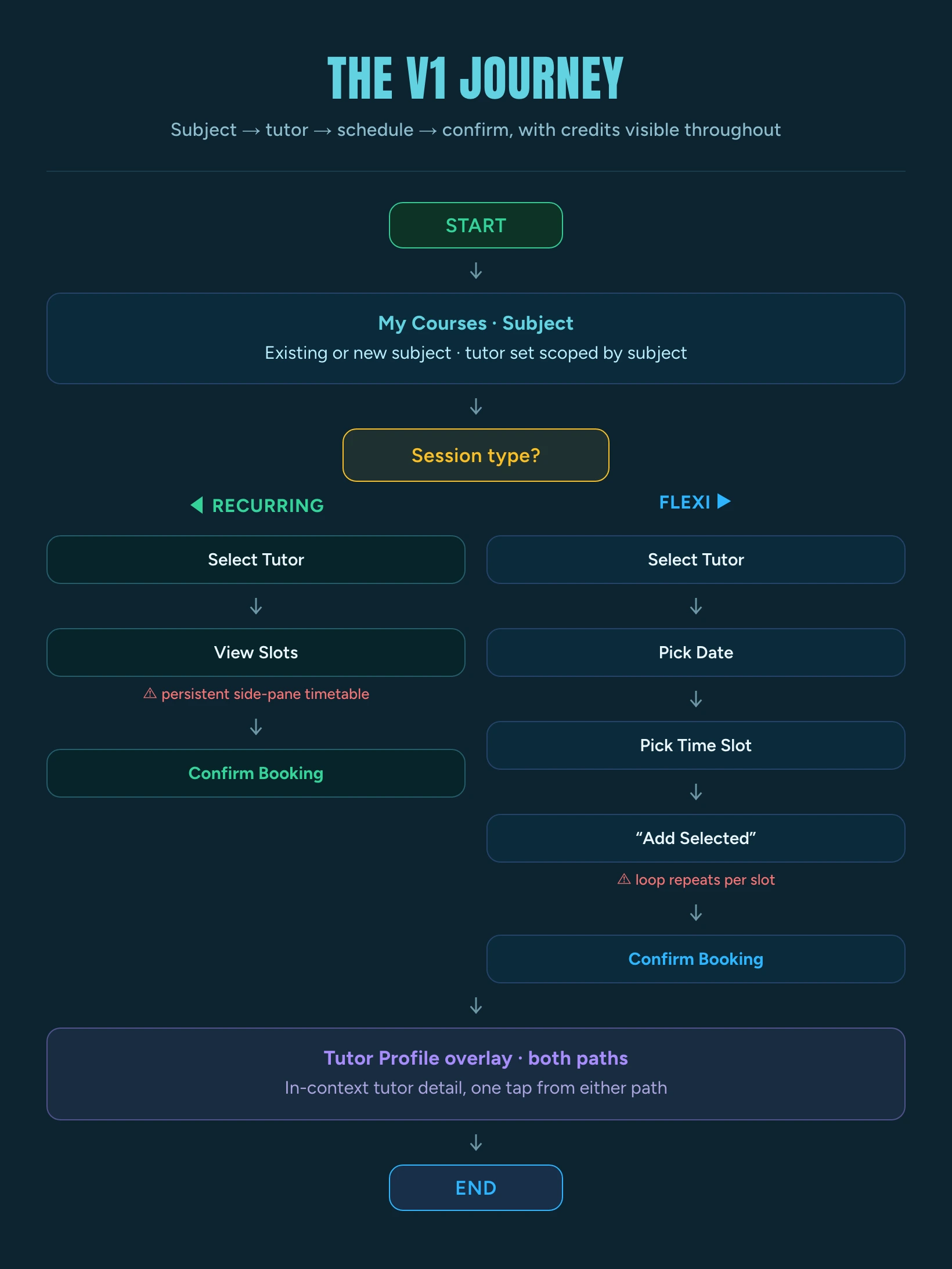
We started from a subject because tutor eligibility and availability depended on it. Learners then compared suitable tutors and chose one. For scheduling, Recurring set a weekly pattern and Flexi supported individual dates.
Protecting retention over the fastest efficiency win

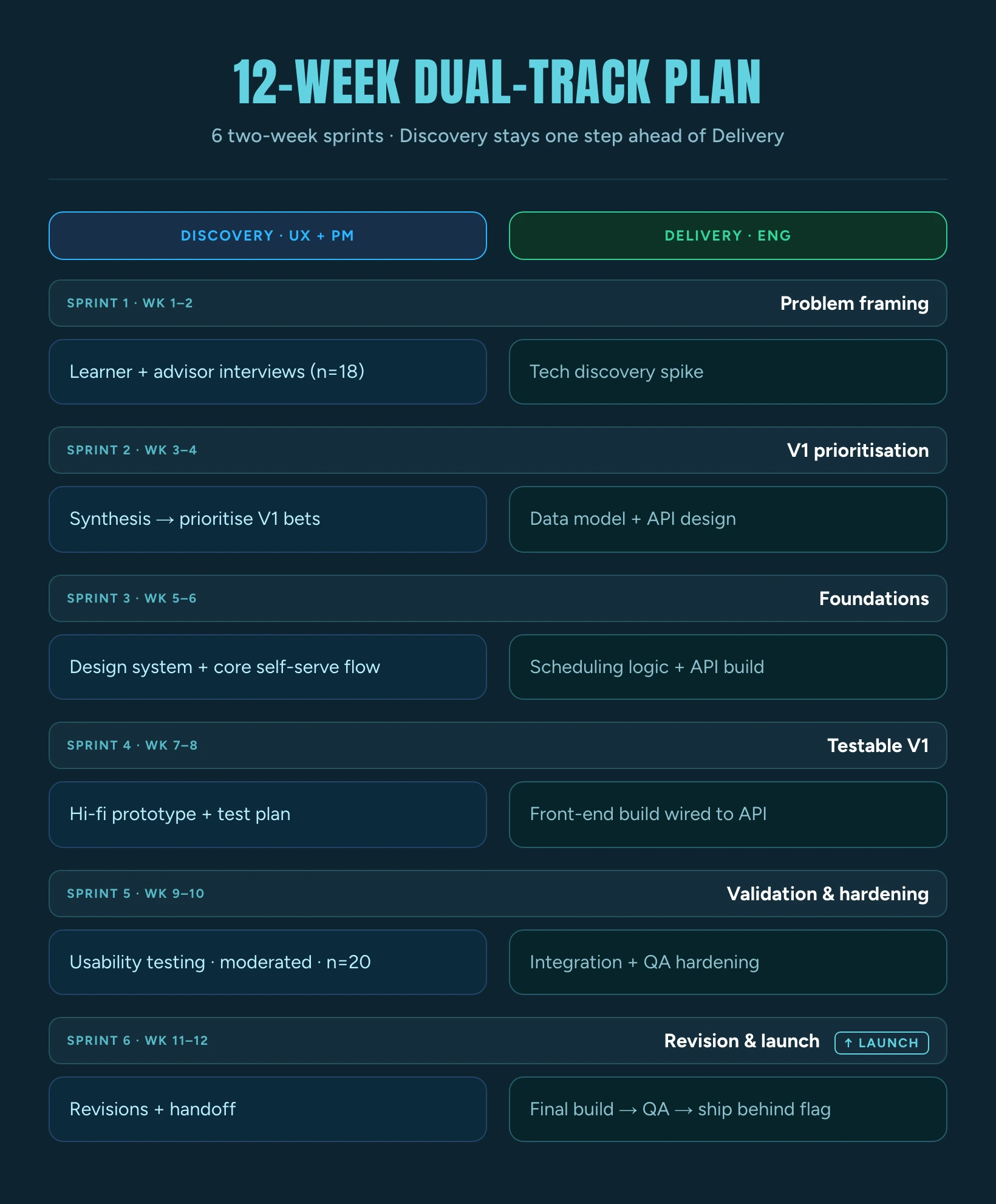
Fig. 2 - The 12-week dual-track plan. I kept research and prototyping one step ahead of engineering.
- 1The amount of Recurring choice learners could compare with confidence.
- 2The feedback learners needed after selecting a Flexi time.
- 3The moments when learners still wanted advisor reassurance.
- 4The way learners checked progress and revised an earlier choice.
- 5The cost of deferring direct previous-tutor entry for returning learners.
V1: a working self-serve booking flow
V1 was not a rough sketch. It introduced the three patterns the product still runs on: a stepped wizard, the tutor profile at the decision point, and a calendar for scheduling. It ran the whole path, subject to tutor to schedule to confirm, with credit use visible throughout, so we could test the self-serve model end to end.

Fig. 3 - The V1 journey, end to end. Subject, tutor, schedule, confirm, with credits visible throughout.
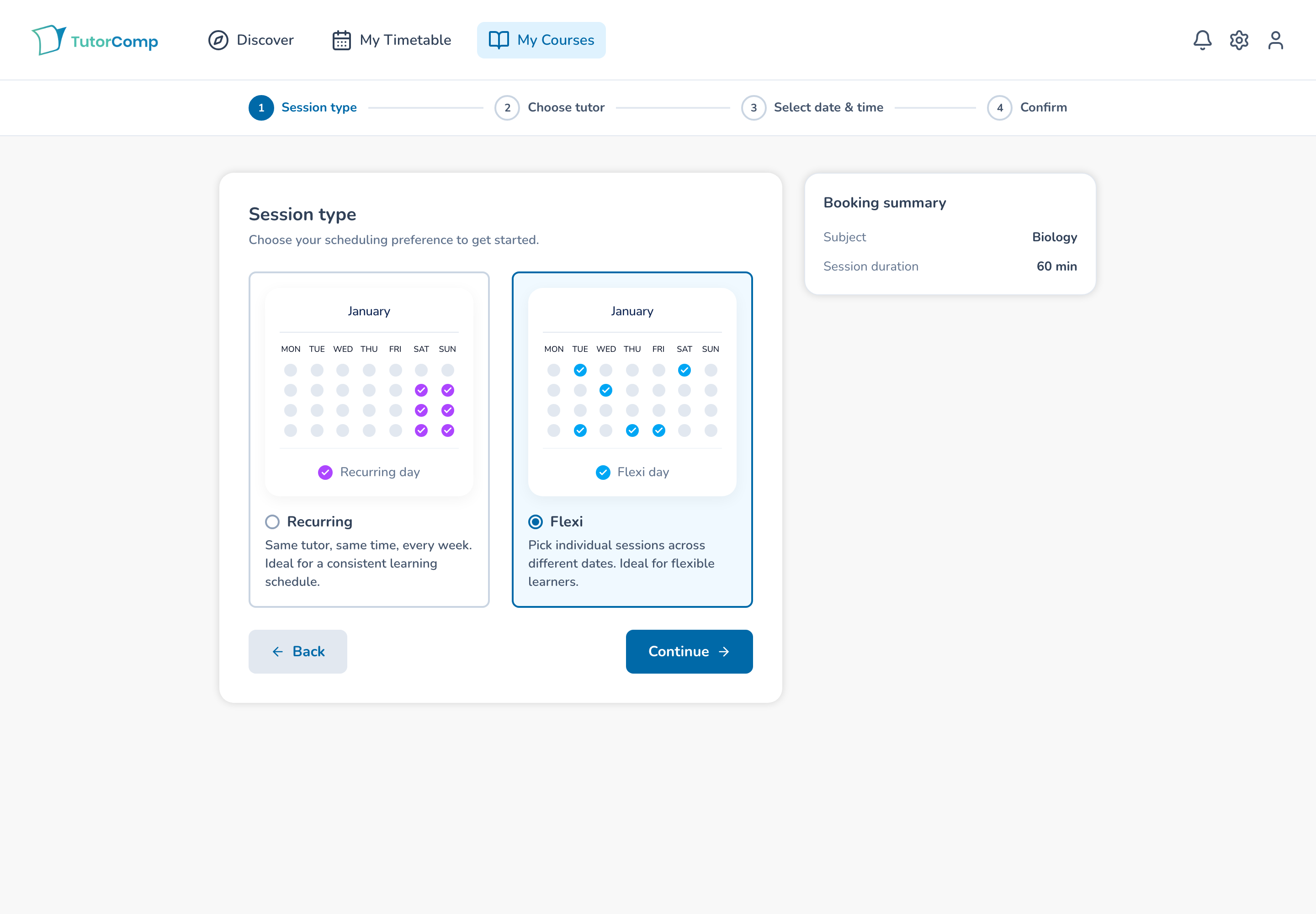
A stepped wizard, so no one booked blind. A booking couples four interdependent choices, subject, tutor, schedule and credits, that advisors used to sequence by hand. V1 made each its own step behind a persistent tracker, so a learner resolved one decision at a time and always saw what was done and what was left. Holding the screen to a single choice is what let an unassisted booking feel safe rather than like a half-filled form.
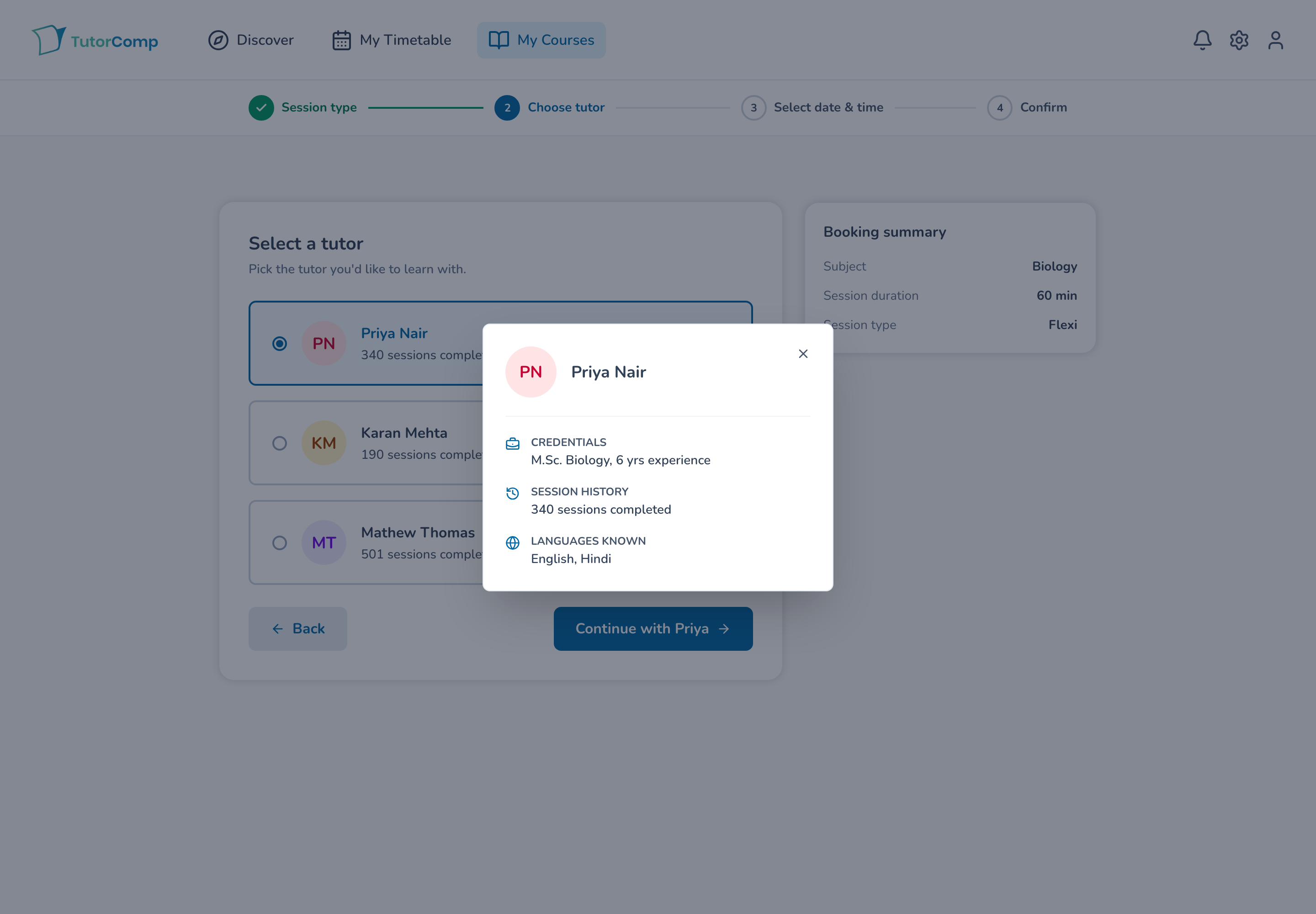
The tutor decision, moved out of the advisor call and into the product. Research had named the tutor profile as the moment confidence was won or lost, and advisors had been supplying that context over the phone. V1 put it in the flow: each card carried subject experience, availability, credit cost and sessions completed, and a View profile popup held full credentials and history. A learner could commit to a tutor without waiting for a human, and testing confirmed this was the part they moved through with confidence.

Fig. 4 - The V1 wizard. A numbered tracker held learners in one step at a time, opening on the Recurring or Flexi choice.

Fig. 5 - The V1 tutor decision. Sessions completed on every card, and a profile popup with credentials and history one tap away.
For scheduling, V1 offered two modes on the same structure, each with a view built for how that decision is actually made.
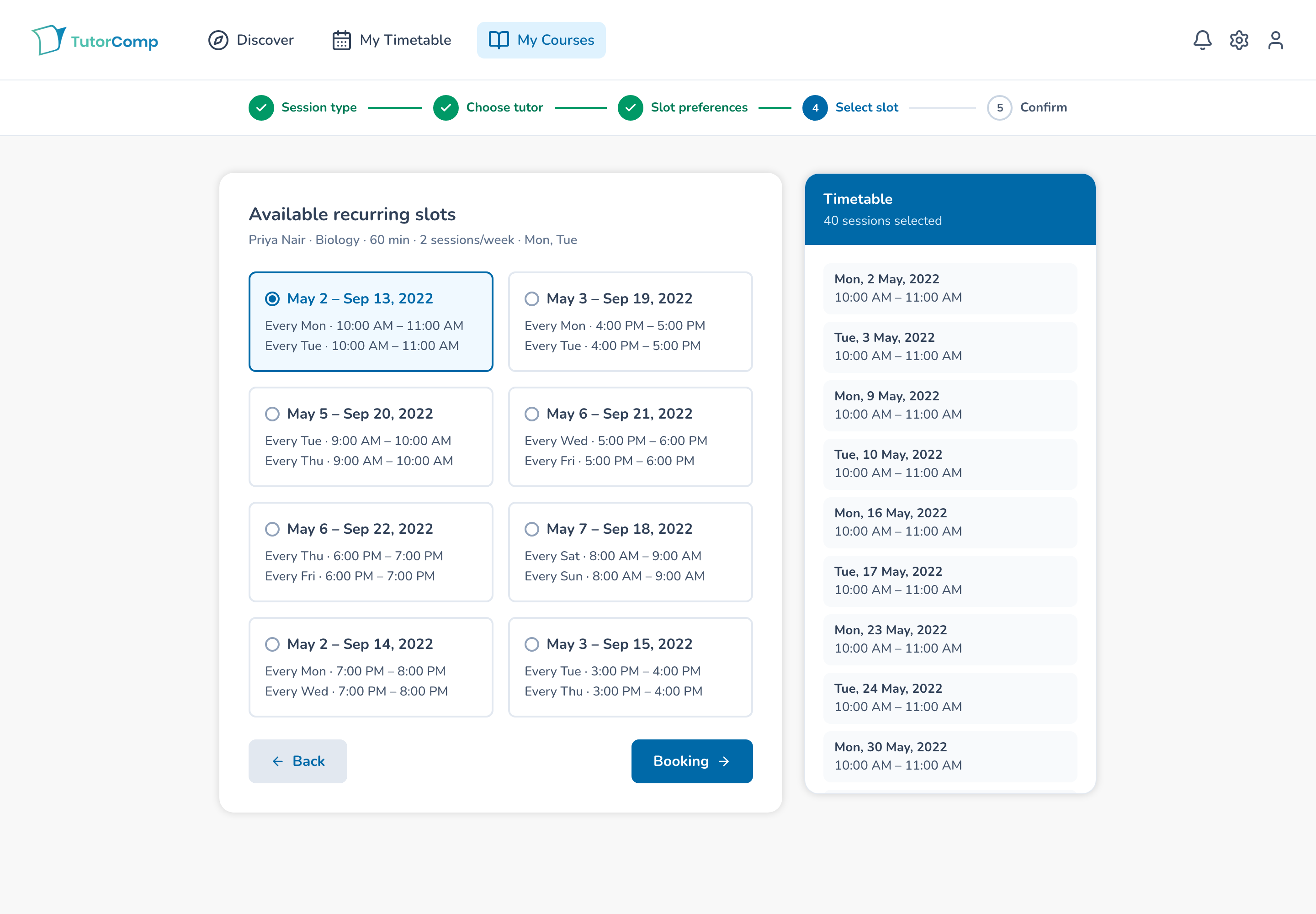
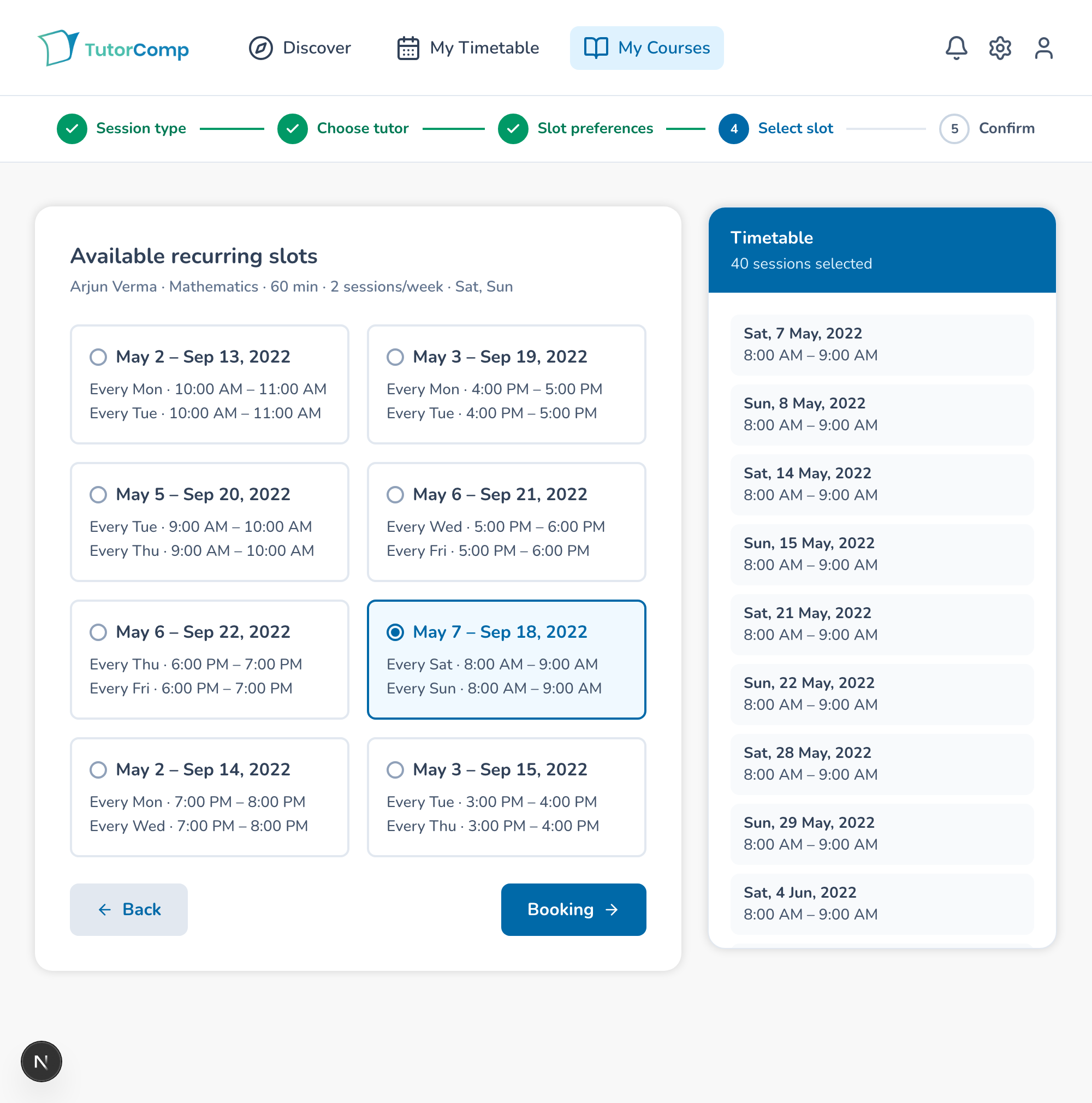
Recurring turned an abstract pattern into concrete dates. Committing to "every Monday and Tuesday" for months is hard to picture, so V1 rendered the chosen pattern into a real timetable, every dated session it would produce, listed beside the choice. Seeing the true commitment, dozens of sessions on named dates, before spending credits is what let learners commit to a long recurring booking with confidence.
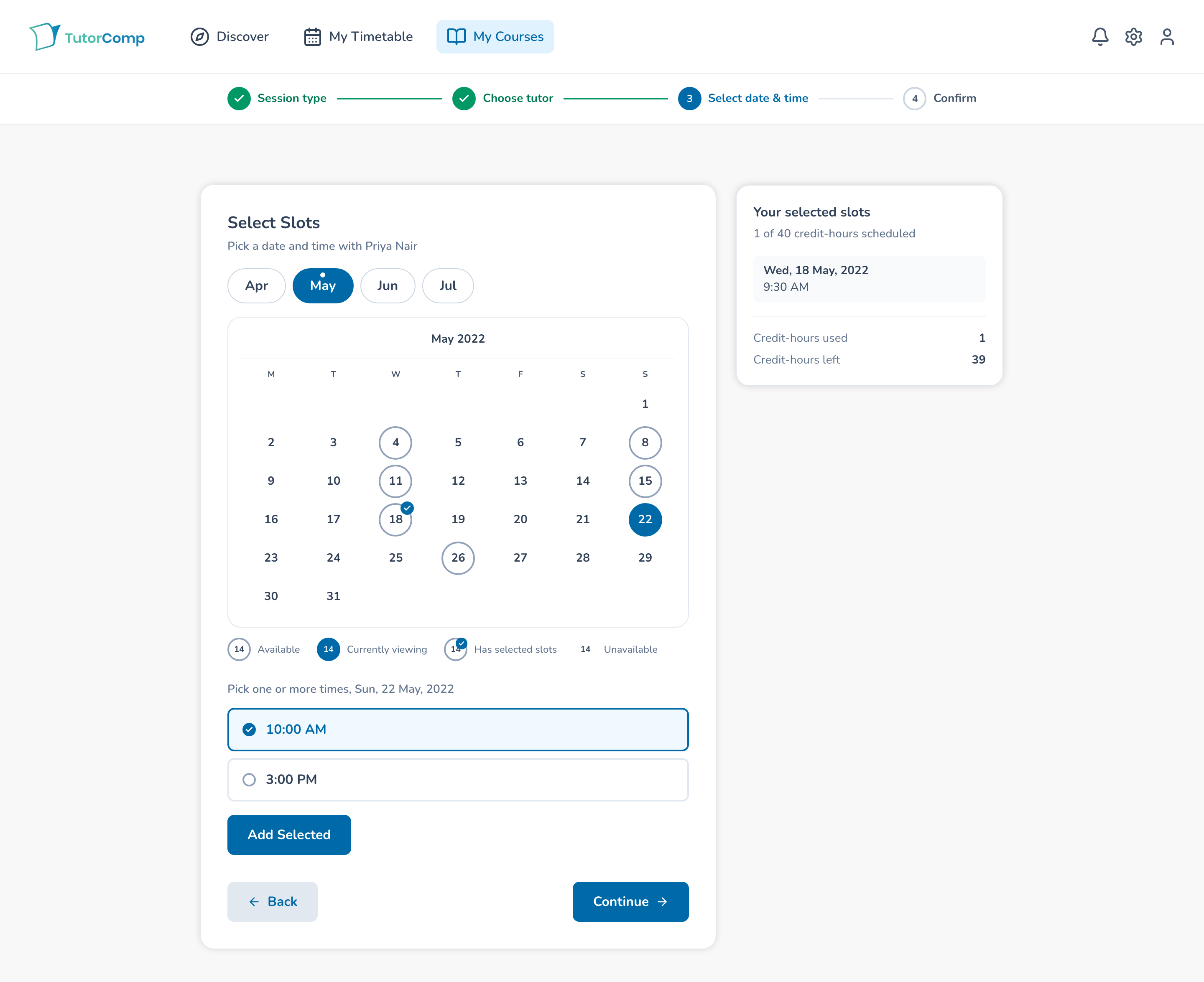
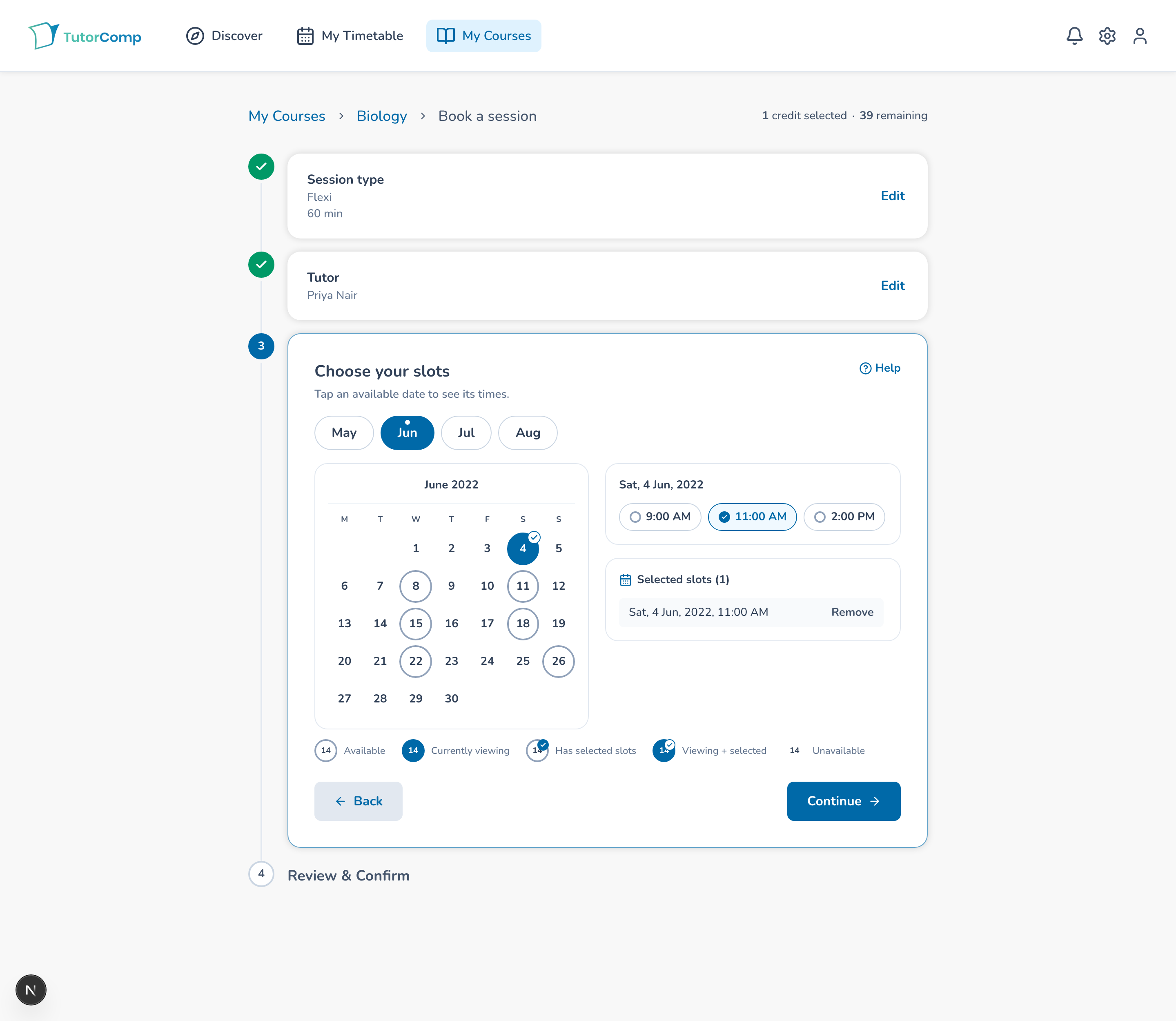
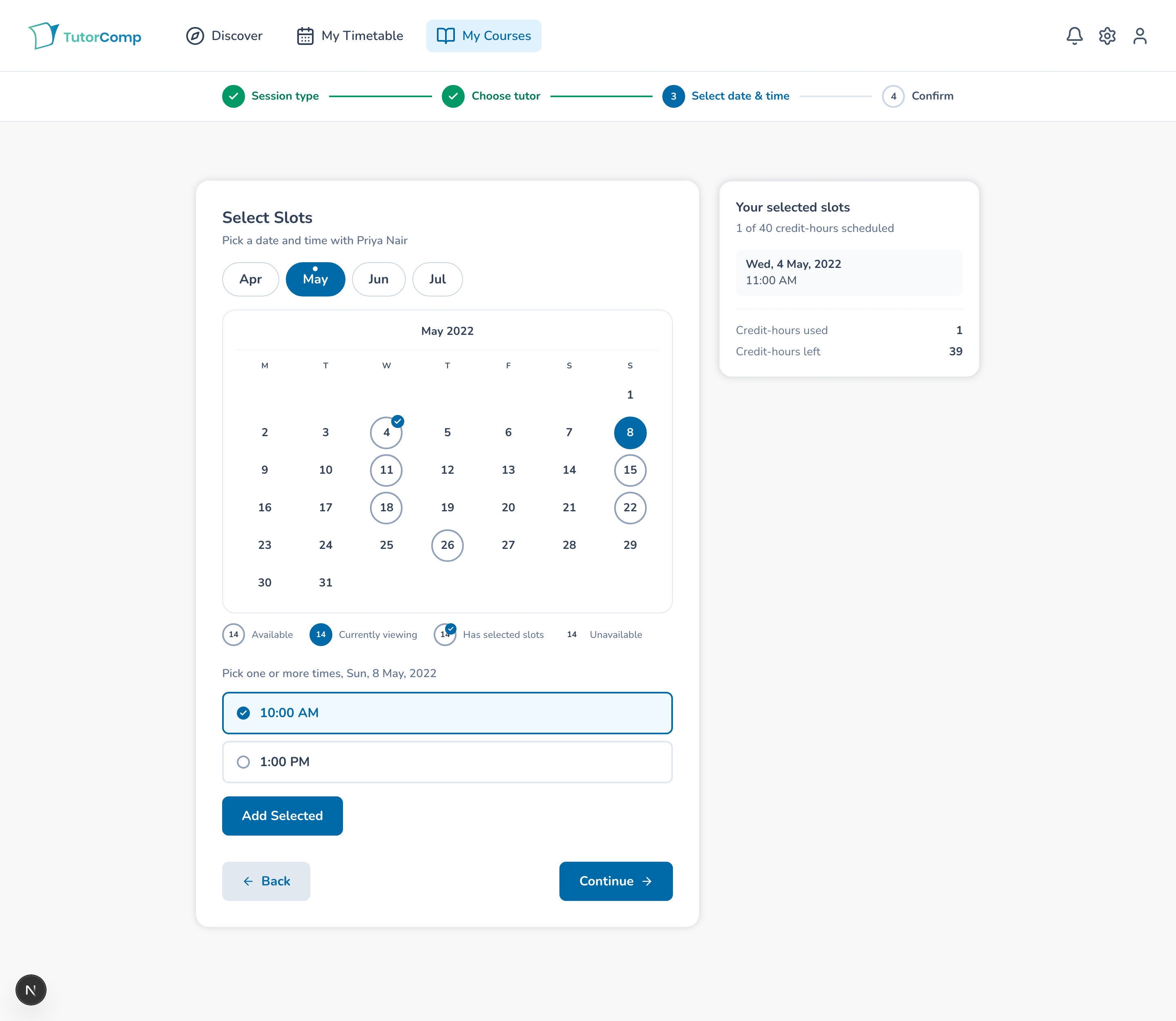
A calendar for Flexi, because dates are spatial. Flexi learners choose individual sessions, and a date is far easier to judge against a month than a dropdown. V1 gave Flexi a real calendar with visible availability and a running list of what had been added, matching the mental model learners already used to plan their week. Scheduling is the part testing would go on to sharpen.

Fig. 6 - The V1 Recurring timetable. Picking a pattern rendered every dated session it produced into a live timetable, docked beside the choice.

Fig. 7 - The V1 Flexi calendar in use. Pick a date, choose one or more times, then Add Selected; each session lands in a running list with credit use counted.
Both modes, end to end, are easier to read in motion than in stills. The clips below walk each flow from choosing a tutor through to a booked schedule.
Video 1 - V1 Recurring: setting a weekly pattern against the full timetable.
Video 2 - V1 Flexi: choosing a tutor, then adding individual dates and times.
The model held; scheduling and feedback needed sharpening
I recruited a separate group of 20 learners for moderated prototype sessions. The group included people new to TutorComp and returning learners. Each person completed four tasks across Recurring and Flexi, from choosing a tutor to reviewing a booking. I watched where they paused, what they expected after each action and when they asked for help.
Learners completed bookings on their own, which validated the self-serve model and the tutor decision. The friction was concentrated in scheduling and feedback. In Recurring, learners scanned a long list of weekly patterns while also checking a timetable. The volume of options slowed comparison.
In Flexi, several learners selected a time and moved to the next step because they expected the product to save the selection. They had missed a separate Add Selected button. Learners also searched between two areas to check progress and earlier choices. Some completed the interaction and still wanted an advisor to confirm the decision before they spent credits.
Five decisions after testing
Make Flexi selections feel immediate
Keep advisor reassurance in the flow
Combine progress, choices and edits
Shorten repeat booking for returning learners
The interaction changes, side by side


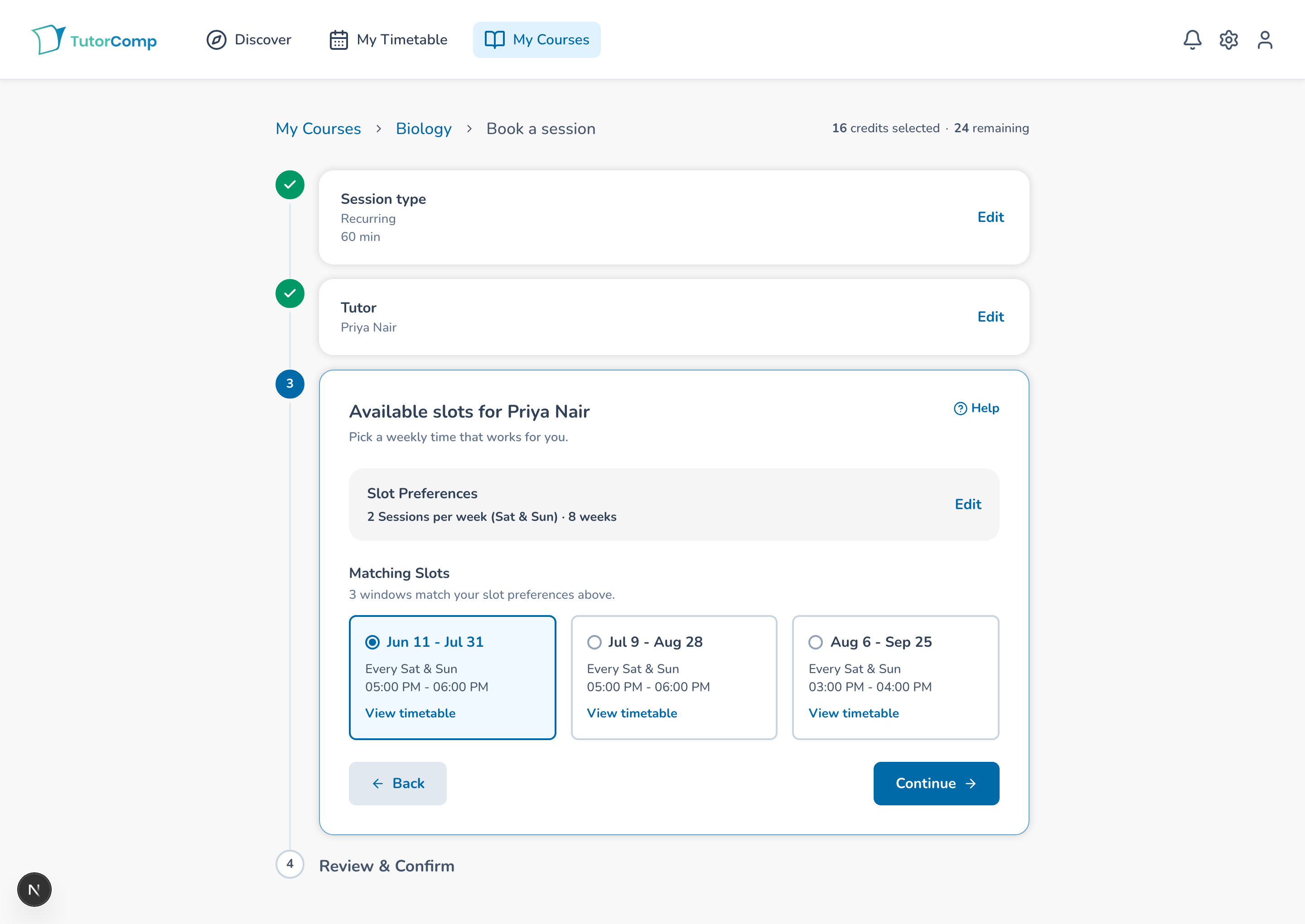
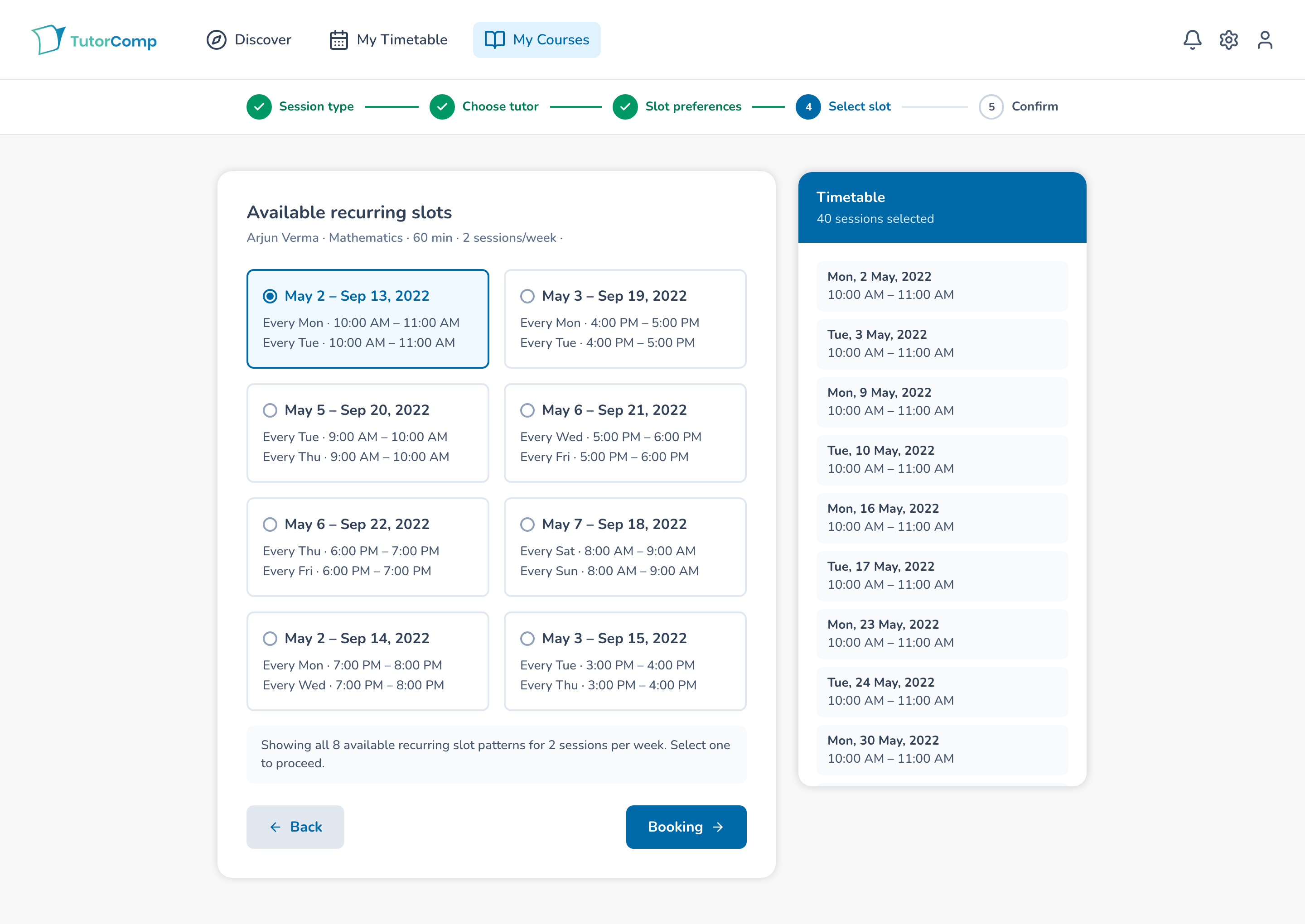
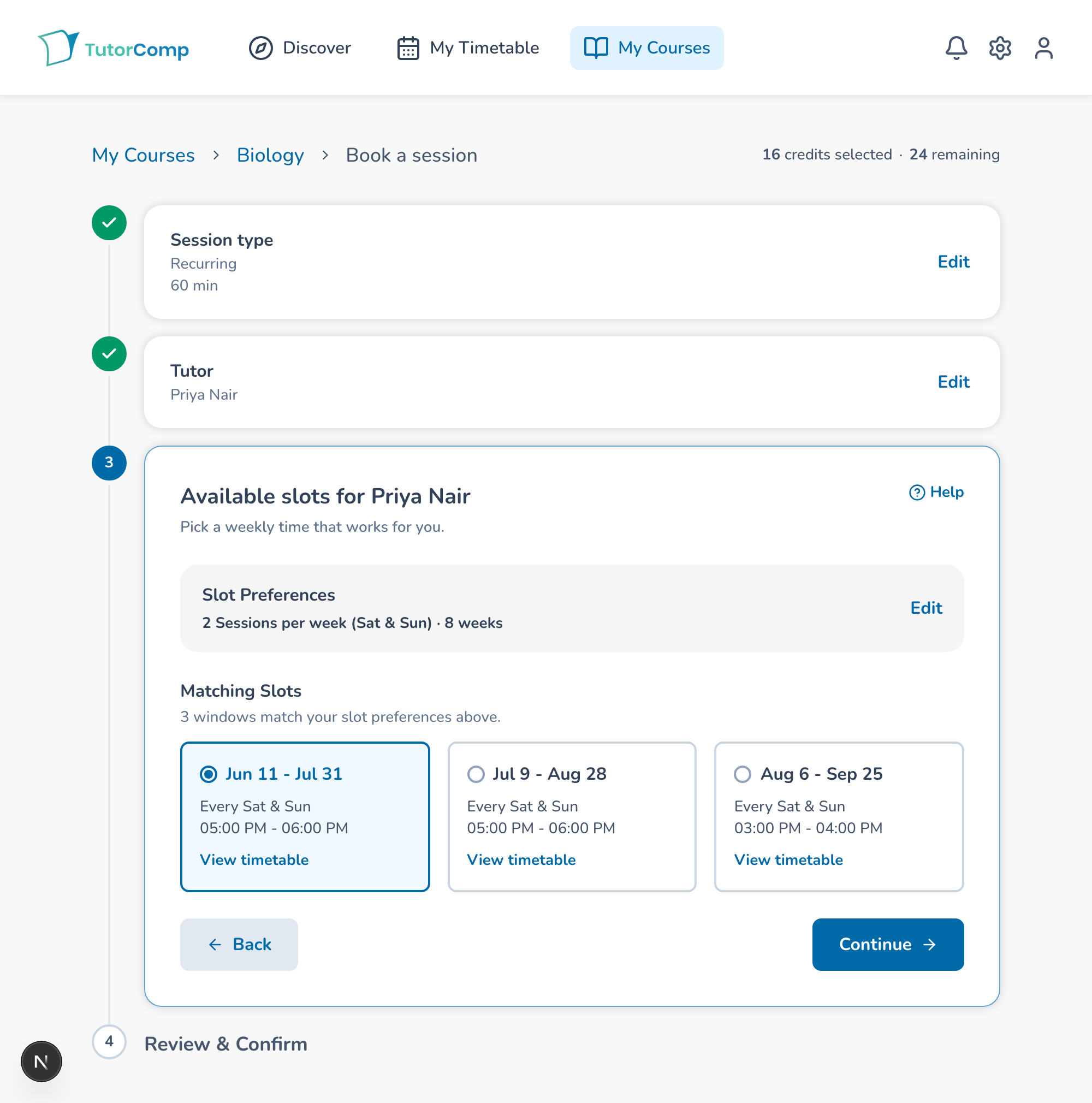
Fig. 8 - Recurring, before and after. The same preferred-day input now returns three strong matches instead of the full pattern list. Drag to compare.


Fig. 9 - Flexi, before and after. Learners now add a time in one action and keep credit use visible. Drag to compare.


Fig. 10 - Progress tracking, same point in both flows: tutor chosen, a slot just selected. V1 splits that state across a stepper, a slot list and a separate summary that still omits the tutor; the revised rail carries every chosen value, including the tutor, in one place with an Edit link. Drag to compare.
Making the case for hiding the timetable

Fig. 11 - The timetable, now on demand. The docked V1 timetable from Fig 6 moved behind a View timetable action, lowering the default load while keeping it one tap away.
New and returning learners took different paths
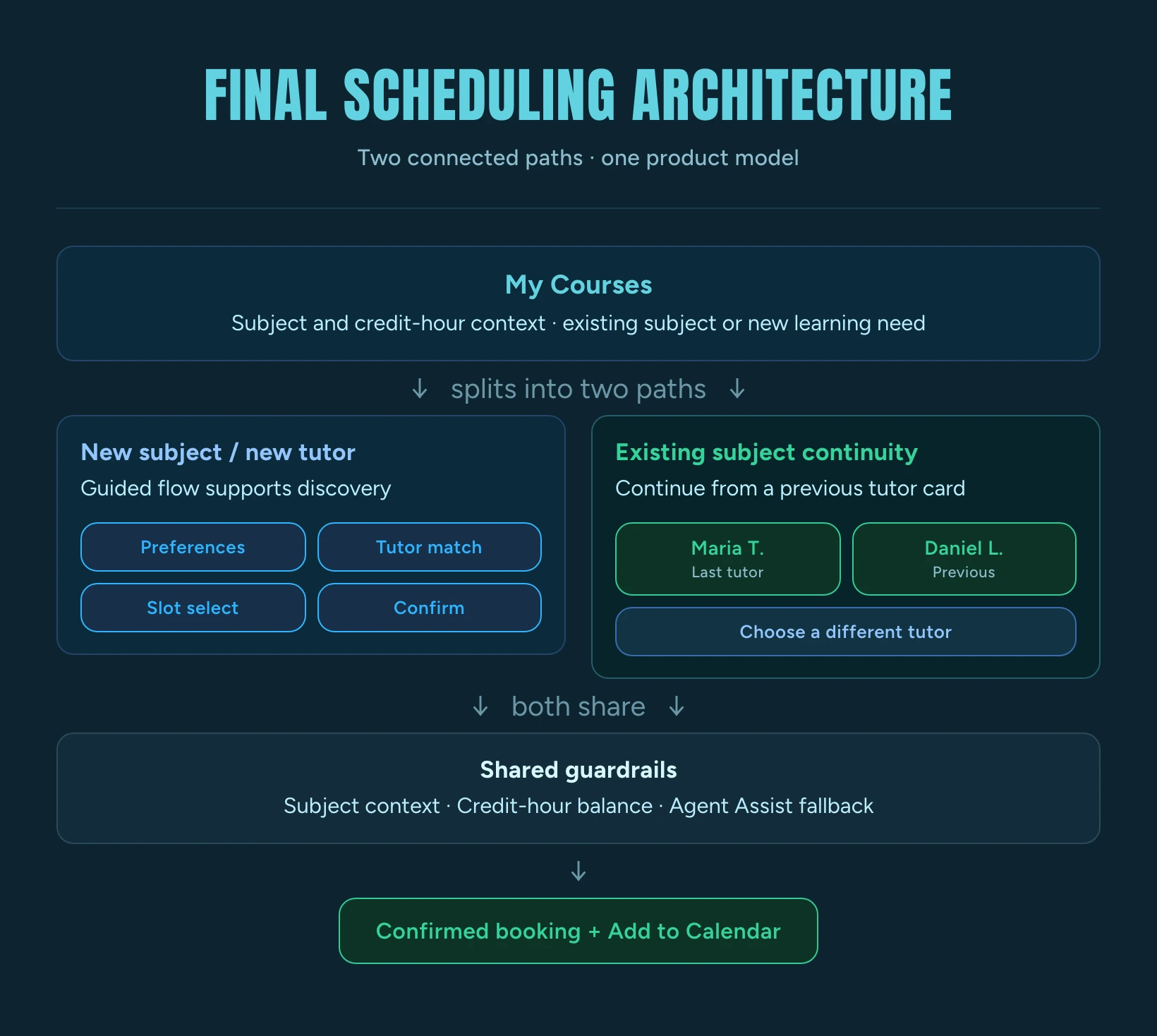
The shipped flow used the learner's subject history to choose a starting point. A learner booking a new subject entered tutor discovery and compared eligible tutors. A learner returning to an existing subject saw previous tutors first and could move from that relationship into scheduling.
After choosing a tutor, the learner built a weekly Recurring schedule or selected individual dates in Flexi. The product kept credit use, selected times and progress visible through confirmation. Because the booking service saved Flexi sessions one at a time, confirmation reported the result of each session rather than a single combined outcome.
Confirmation closed with a receipt, not just a message: the tutor, schedule and credits spent stayed on screen, with a calendar download and a link to the learner's session list, so nothing about what had just been booked required a lookup elsewhere.
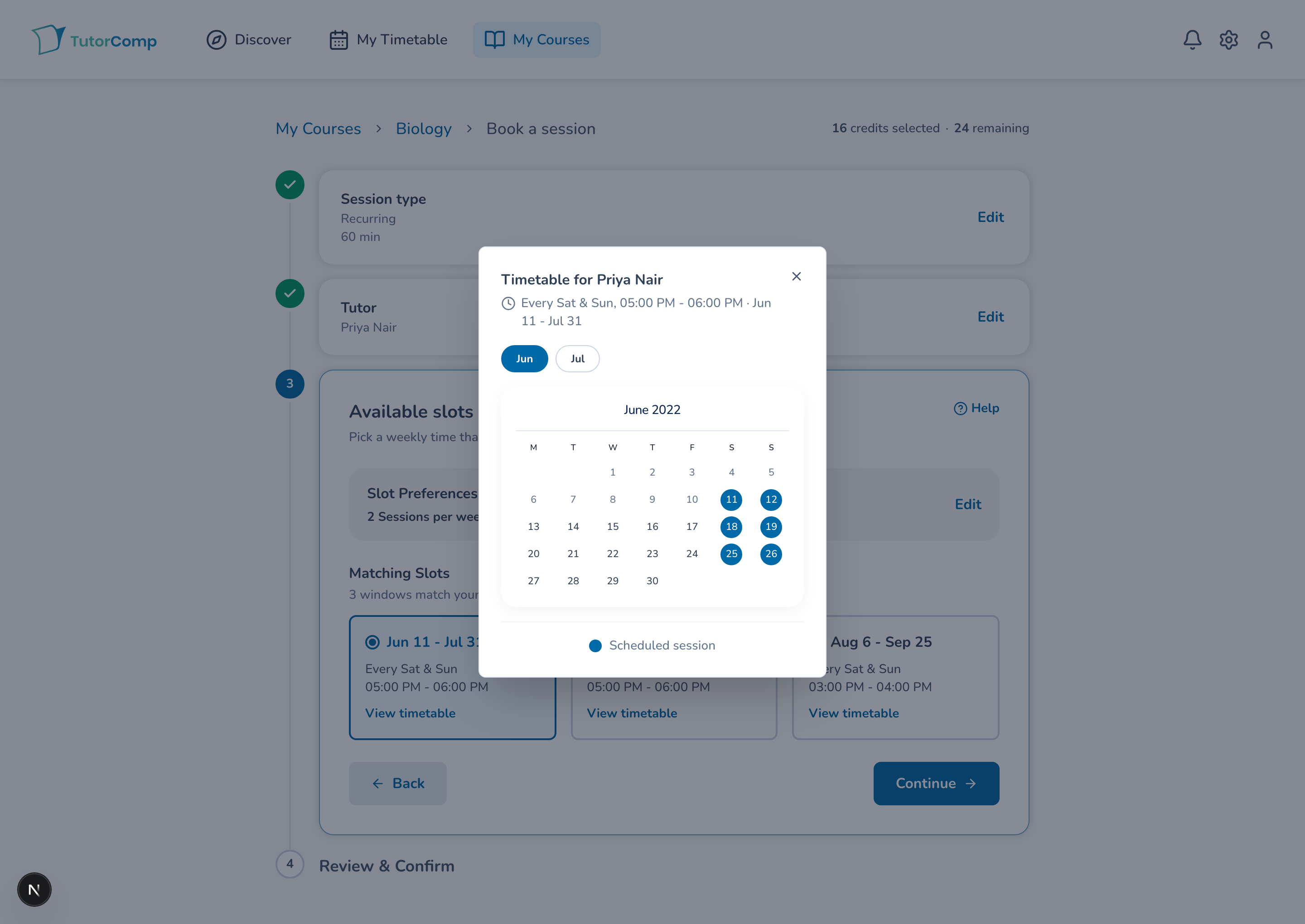
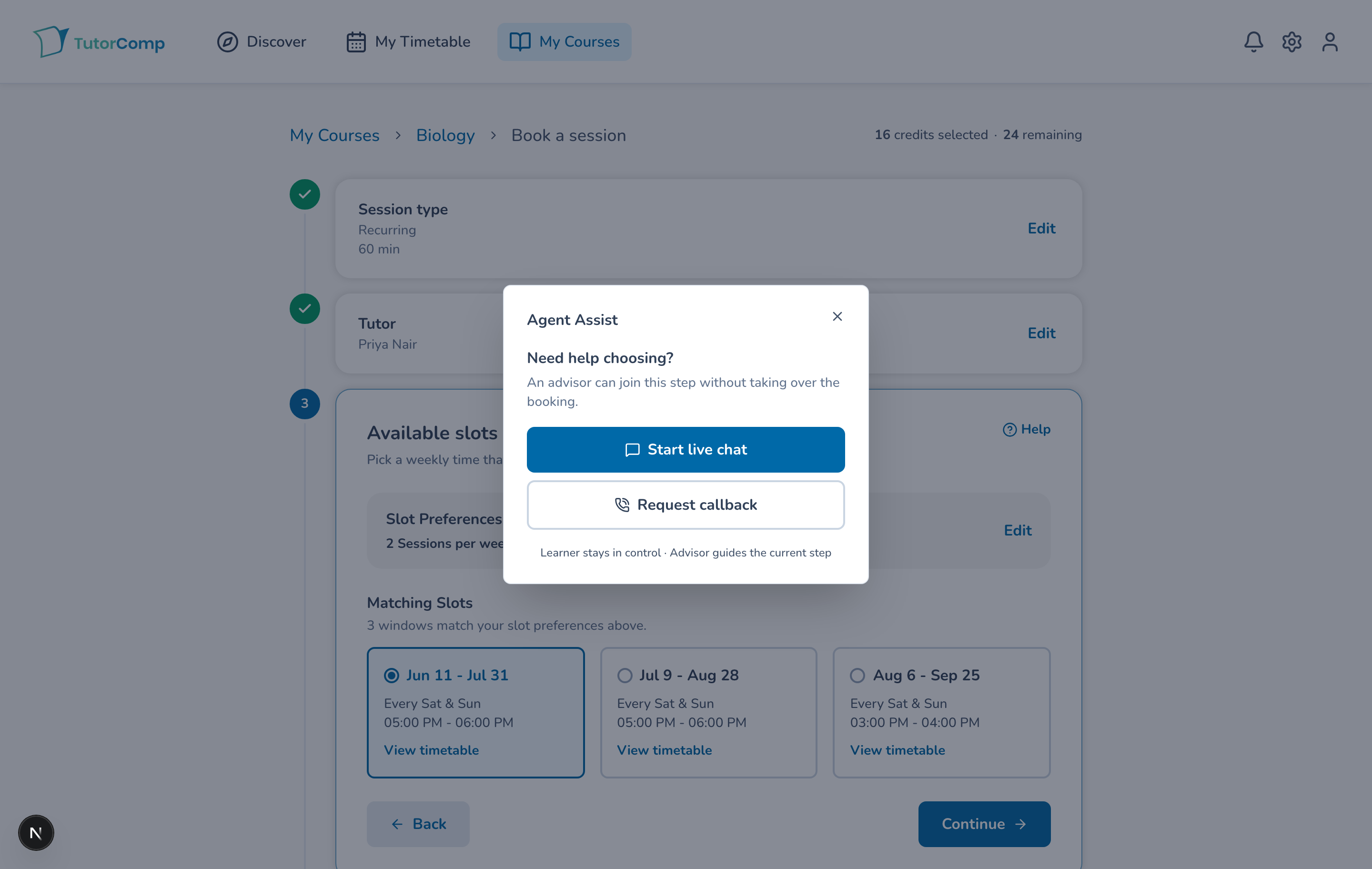
Help stayed inside the task and escalated only as far as a learner needed, from lightweight self-help up to a live advisor. Their subject, tutor and schedule choices remained in place at every step, including through an Agent Assist conversation.

Start a new subject

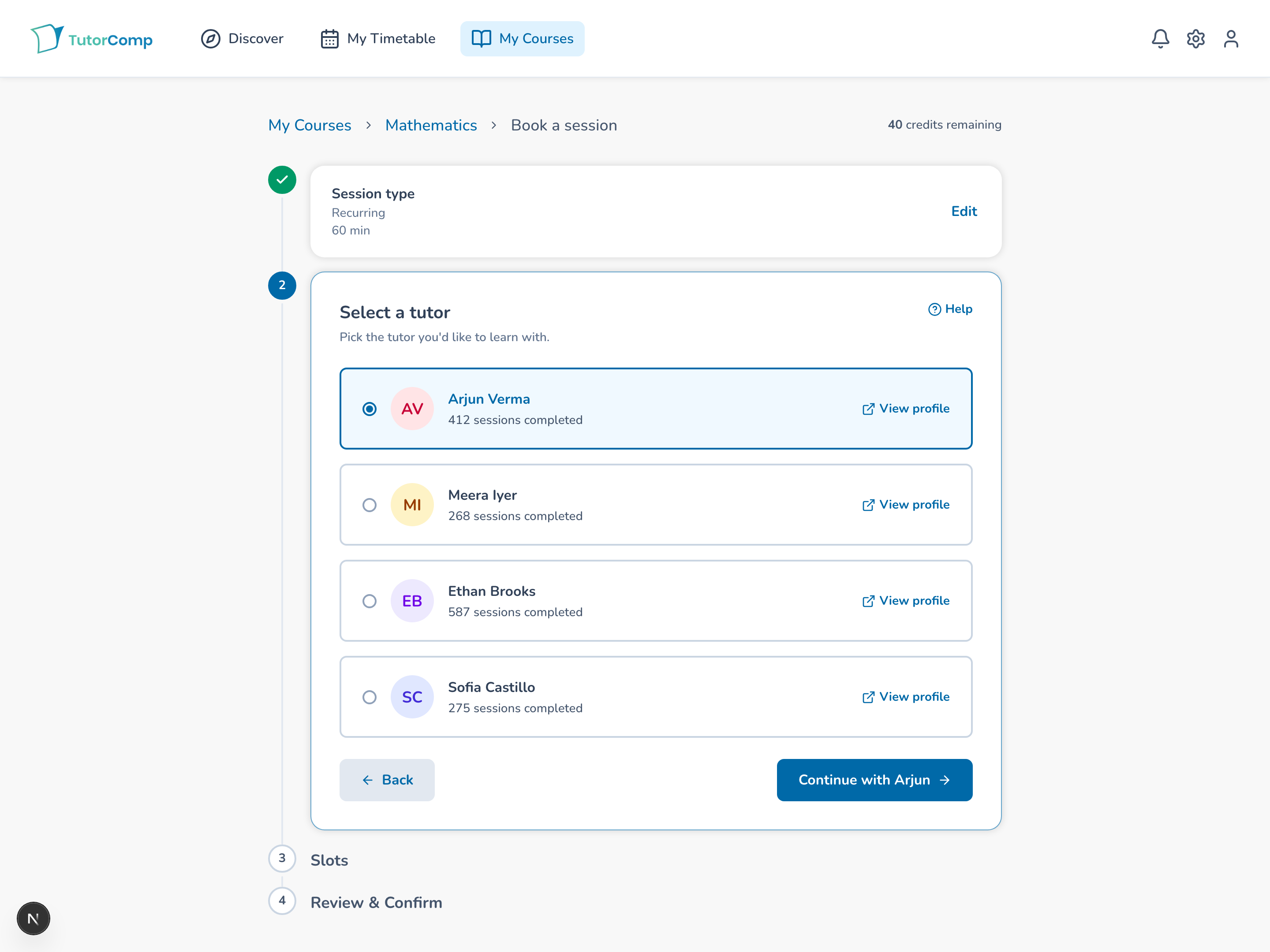
Fig. 12 - The new-subject path. The tutor decision from V1, now inside the step rail that carries subject, tutor and credits forward.
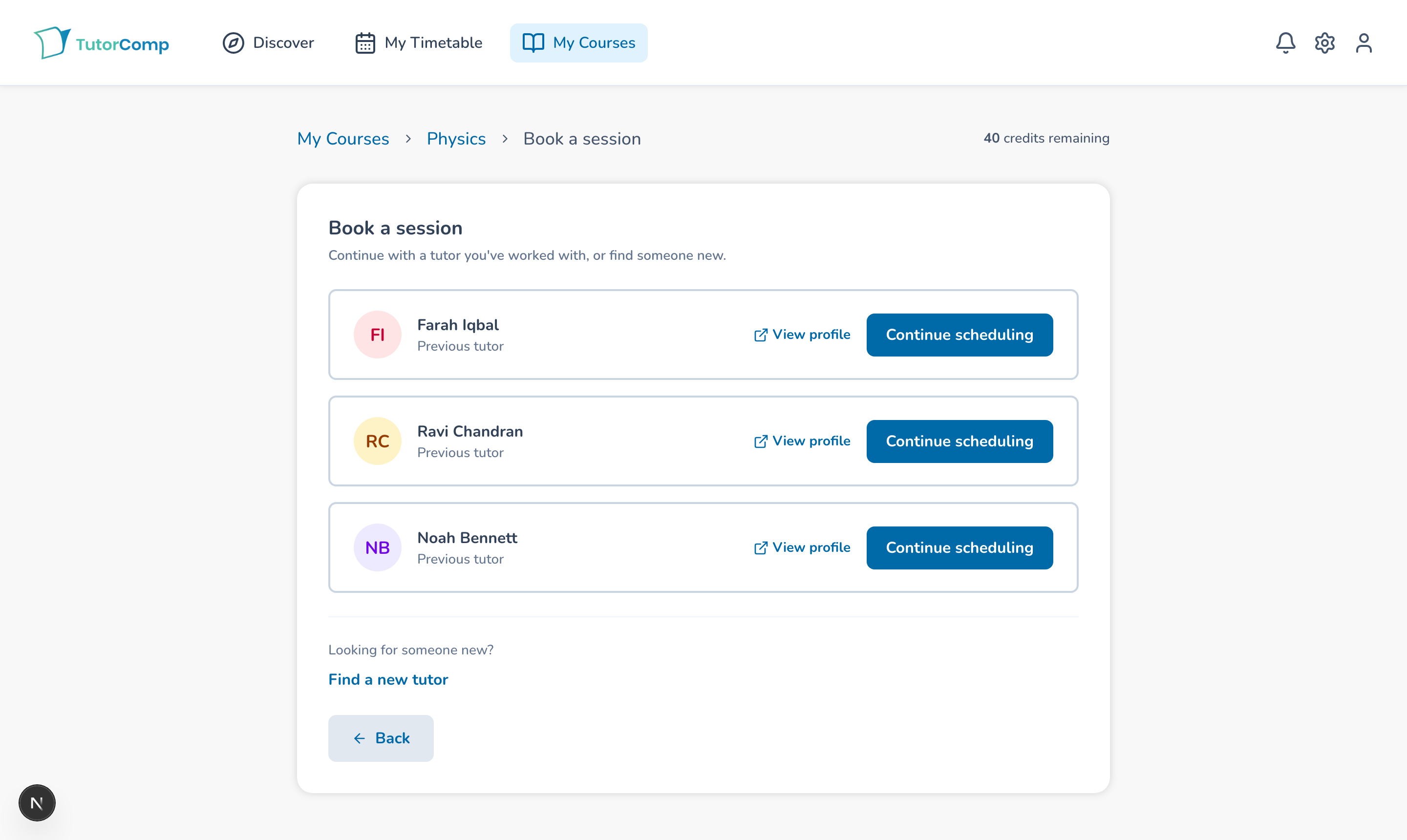
Continue with a previous tutor

Fig. 13 - Continuity for returning learners. They can schedule with a previous tutor or find someone new.
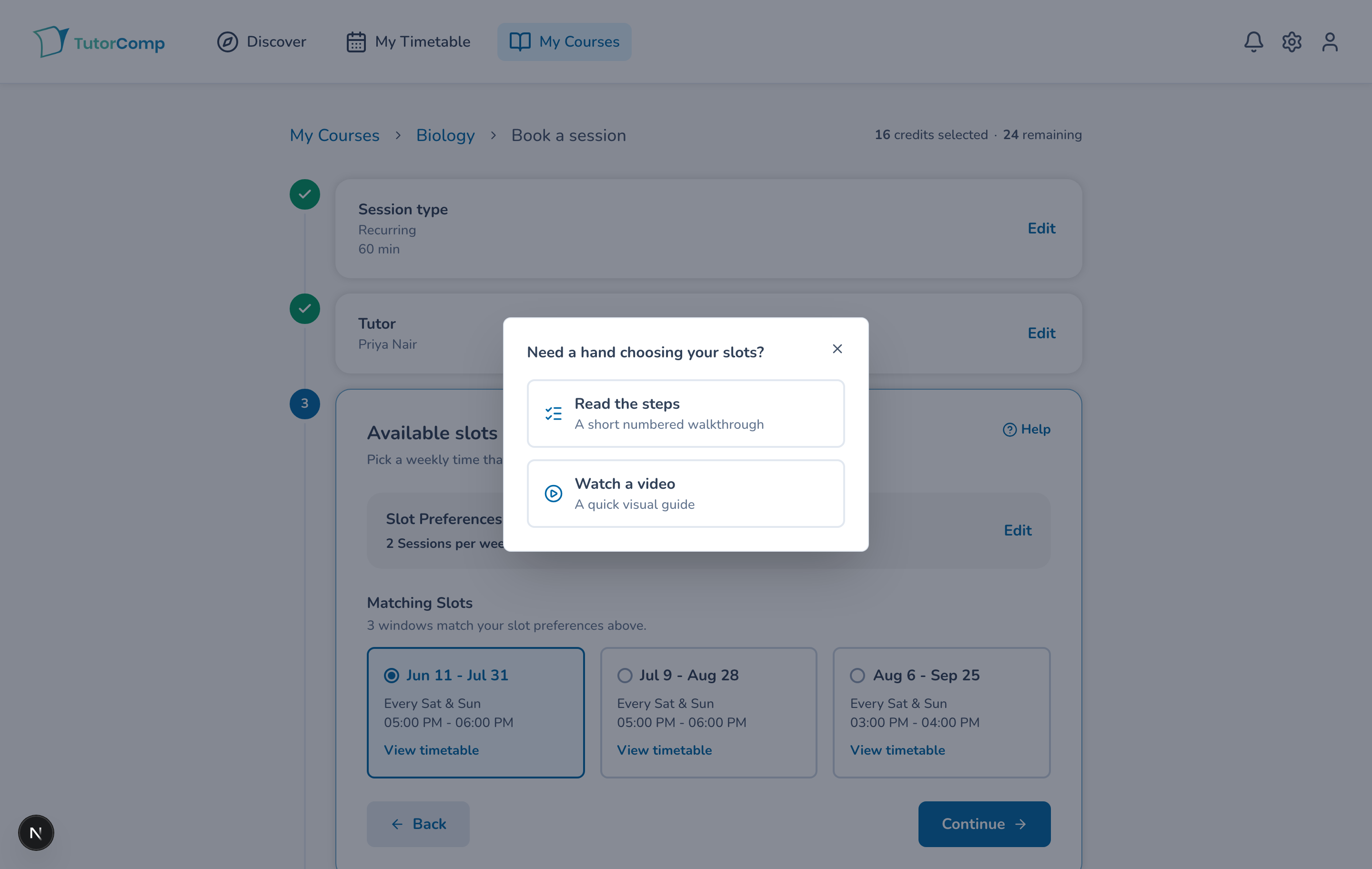
Get help inside the flow

Fig. 14 - Contextual help. Two lightweight options, a numbered walkthrough or a short video, before it escalates to an advisor.

Fig. 15 - Agent Assist. Learners keep their booking choices while starting a chat or requesting a callback.

Fig. 16 - Final scheduling architecture. New subjects enter discovery; returning learners start with previous tutors.
Revised walkthroughs
Video 3 - Revised Recurring: three matching schedules, an on-demand timetable, straight to confirmation. Compare with Video 1.
Video 4 - Revised Flexi: direct multi-selection with visible credit use. Compare with Video 2.
The team started small, then expanded access
The 12-week design and build ended in April 2022. The team then moved into a staged rollout, starting with one learner cohort before expanding access.
Learners created real sessions and spent prepaid credits through the redesigned flow. A failure could leave a learner with only part of a Flexi schedule or send them back to an advisor. The team wanted evidence from real bookings before giving the full learner base access.
We separated rollout learning from outcome measurement. The first two weeks focused on failures, support questions and unclear instructions. Adoption tracking began when the full learner base could use the flow.
What I would carry into the next build
Research is an alignment tool, not just an input
Recordings, advisor interviews and synthesis gave product, engineering and operations one view of the problem. That shared evidence turned tradeoff conversations from territorial into practical, as when the session recordings settled whether to hide the timetable.
Model the service before drawing the flow
I revisited screens whenever a change affected tutor history, credits or support. Next time I would map those relationships before prototyping and use the map to guide each flow.
Simplicity is a product tradeoff, not a coat of polish
Every control I removed changed what was default, what was on demand and what reassurance learners still needed. The work was making those tradeoffs explicit enough to cut cognitive load without cutting confidence.
Plan the human fallback as an operating model
I kept the advisor channel live through the trial but treated it as a stopgap. Next time I would define the in-flow support path and how it is staffed and retired before the build, not during it.
Instrument and test the full experience earlier
V1 testing focused on tutor choice and scheduling, so I would add a round covering continuity, help escalation and partial Flexi failures before the trial cohort. Operational outcomes also rested on advisor reports, so I would instrument handling time, escalation rate and time-to-book from launch rather than reconstruct them later.